ZoomZoom Cloud Inc
Cloud Consulting / Professional Services · Founder-led
The Challenge
When ZoomZoom Cloud launched, the founding team faced the same question every new consultancy does: how do you build a credible, high-quality web presence fast, without a six-figure agency retainer and a six-month timeline?
The traditional path — brief a digital agency, go through discovery, design, development, review cycles, launch — is designed for organisations with budget, time, and a team to manage the process. For a founder-led cloud consultancy, it is the wrong tool entirely. The cost is prohibitive, the pace is incompatible with getting to market, and the result is a site you can’t update without going back to the agency.
The requirements were clear: the platform had to be production-grade from day one, globally fast, secure, cost-effective to host at any scale, and something the team could own, extend, and update entirely themselves — without a CMS vendor, a hosting subscription, or an external dependency.
Our Approach
We designed and built the entire platform in-house, using AI-assisted development throughout and treating the website itself as a demonstration of the same principles we apply to client engagements: infrastructure as code from the start, automated delivery pipelines with human review gates, and security built in rather than bolted on.
Architecture: Static Site on AWS
The platform is built on a static site architecture hosted entirely on AWS. Pages are pre-rendered at build time and served directly from Amazon S3 through Amazon CloudFront’s global edge network. There is no server to manage, no runtime to patch, and no database to back up. The result is a site that serves pages in milliseconds to visitors anywhere in the world, scales automatically to any traffic volume, and costs less than a dollar a day to operate — regardless of audience size.
Amazon CloudFront handles global content delivery with HTTP/2 and HTTP/3, edge compression, and a full security headers policy including HSTS preload, Content Security Policy, and X-Frame-Options. Origin Access Control ensures S3 is never exposed directly. All infrastructure is defined in CloudFormation — every resource is reproducible, every change is reviewed.
CI/CD Pipeline with Human Approval Gates
The delivery pipeline automates everything that should be automated and puts humans at every decision point that matters. The flow is straightforward:
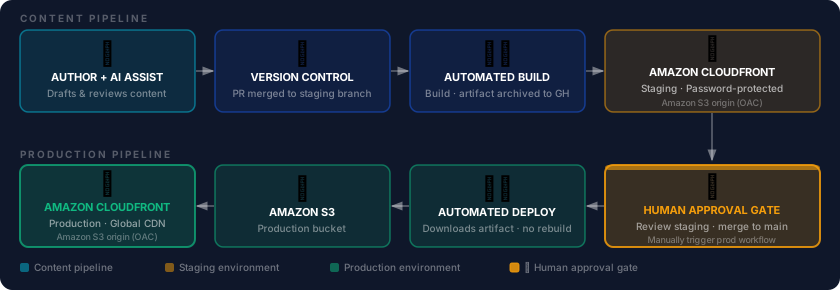
An author creates or updates content with AI assistance and opens a pull request against the staging branch. On merge, the pipeline triggers automatically: it builds the full site, runs type checks, packages the output into a versioned artifact, archives it to GitHub Releases, and deploys to a password-protected staging environment on Amazon CloudFront. A stakeholder reviews the live staging site. When satisfied, a second pull request promotes staging to main and the production deploy is triggered manually from GitHub Actions — downloading and deploying the exact same artifact that was reviewed on staging, with no rebuild. The same bytes that passed review are what go live. The entire staging-to-production cycle completes in under 60 seconds.
No manual file transfers. No FTP. No “remember to clear the cache.” Every change is tracked, every deployment is logged, and the pipeline enforces the same process whether it’s a single sentence edit or a major content update.
AI-Assisted Development and Content Workflow
AI assistance was used throughout the build — for code generation, content drafting, infrastructure review, and problem-solving. This is not a gimmick; it is a genuine multiplier on a small team’s output. Features that would take days were done in hours. Content that would require a copywriter and multiple review rounds was drafted, iterated, and published in a single session.
The content workflow is deliberately simple: write markdown, commit, push. The platform handles the rest. New blog posts, case studies, and service page updates go from draft to live in minutes, with a staging review in between. There is no CMS login, no plugin to update, no vendor to call.
Security and Compliance
Security was designed in from the first resource. CloudFront Function-based password protection on staging prevents pre-release content from being indexed or accessed. The CI/CD pipeline authenticates to AWS via OIDC — no long-lived credentials are stored anywhere. All S3 buckets block public access; only CloudFront OAC can read objects. Security response headers are enforced at the CloudFront layer on every response.
A fundamental security property of the static site architecture is worth stating explicitly: there is no application server, no database, and no server-side runtime in the production environment. The deployed site is pre-rendered HTML, CSS, and assets stored in S3 and served through CloudFront. There is nothing to exploit at runtime. SQL injection, remote code execution, server-side request forgery, and the broad category of application-layer attacks that affect traditional web platforms simply do not apply. The attack surface is reduced to the CDN and DNS layers — both managed by AWS.
The Result
The platform went from concept to production in days, not weeks or months — a 100X improvement in time to value over a comparable traditional agency engagement. DevOps costs are 20X lower than a conventional pipeline setup with dedicated tooling, managed CI/CD services, and the engineering overhead that typically accompanies them. Ongoing hosting costs are under a dollar a day, with a cost profile that barely moves as global audience grows.
The site is served from Amazon CloudFront’s global edge network, which means a visitor in Tokyo gets the same sub-100ms response time as a visitor in Toronto. As the audience grows — whether that is dozens of visitors or hundreds of thousands — the infrastructure scales automatically and the cost profile barely moves. There is no capacity planning, no scaling event, no infrastructure incident at 2am.
More practically: the team updates the site themselves, publishes content in hours, and deploys to production with confidence because every change goes through staging first and every deployment is automated and repeatable.
This is what it looks like when you apply the same engineering discipline to your own platform that you bring to client engagements.
Similar challenges?
Get in touch to discuss your situation. The first call is free, and we'll give you a direct view of how we'd approach it.
Book a Discovery Call